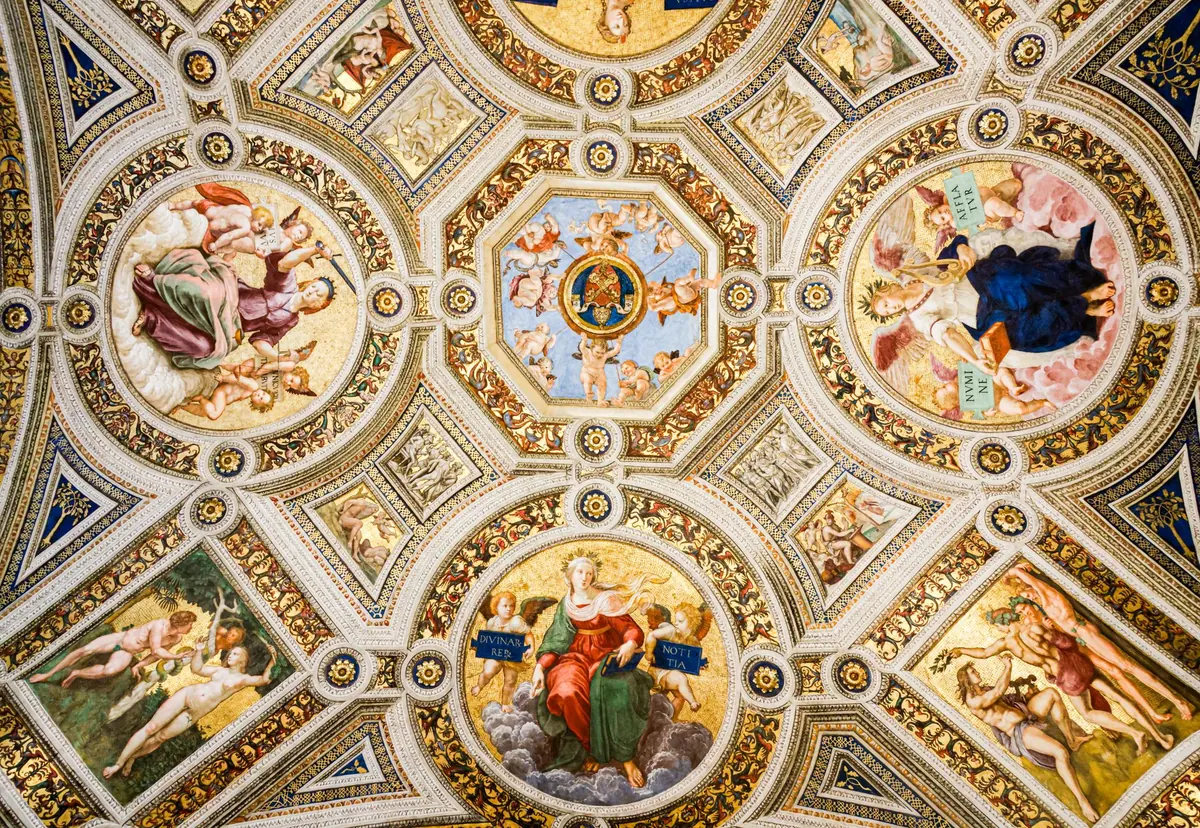
A fresco is painted into wet lime plaster, which means it is part of the wall and cannot be sold, moved or hung over the sofa of a private collector. It stays where it was made, at the height it was made for, under whatever light the building gives it. That is why Florence rewards slow looking rather than a checklist. The masterpieces here are not in one gallery; they are scattered through chapels, refectories and cloisters, often a short walk apart below street level. What follows is a route through the best of them, with the kind of details that decide whether you spend twenty quiet minutes in front of a wall or five rushed ones.
Brancacci Chapel: The Room That Changed Painting
Start in Oltrarno, in the bare, unassuming church of Santa Maria del Carmine. The Brancacci Chapel is small enough to take in at a glance and dense enough to hold you for an hour. Masaccio painted the Expulsion from Paradise and the Tribute Money here in the 1420s, and the figures have weight and shadow in a way that earlier painting did not. Masolino worked alongside him; Filippino Lippi finished the cycle decades later, and you can feel the style shift from one wall to the next.
Entry is timed and numbers are limited, so book ahead, especially between April and October. Mornings are calmer. The chapel is a working place of worship as well as a museum, so keep voices low, and expect photography rules to be posted and enforced.
Santa Maria Novella: Masaccio, Filippino and a Whole Cloister
Near the station, Santa Maria Novella holds three frescoes worth a detour each. High up the left wall of the nave is Masaccio's Trinity, painted around 1427. Its vanishing point is at eye level for a standing adult, which is precisely the point: it is one of the first paintings to build a believable three-dimensional space with perspective, and you should look at it standing, not sitting.
The Tornabuoni and Strozzi Chapels
In the choir behind the altar, Domenico Ghirlandaio's Tornabuoni Chapel runs through the lives of Mary and John the Baptist in a way that doubles as a portrait gallery of 1480s Florentine society — merchants, servants, fashionable women, all with individual faces. Across the transept, Filippino Lippi's Strozzi Chapel is busier and stranger, with antique ornament and a restless energy. The Cappellone degli Spagnoli, reached through the Green Cloister, has a huge allegorical fresco by Andrea di Bonaiuto that includes a view of Florence itself as a walled city.
One ticket usually covers the church and cloisters. Services take priority on Sunday mornings; wait until Mass ends rather than wandering.
Santa Croce: Giotto and the Aisle of Chapels
The Franciscan basilica of Santa Croce holds the largest group of Giotto frescoes in Florence, in the Bardi and Peruzzi chapels in the right transept. Look for the Death of St Francis in the Bardi chapel and the Raising of Drusiana in the Peruzzi: the gestures are restrained, the staging simple, the emotional effect enormous. Note that many chapels here are behind glass and roped off, and the lower painted bands have faded badly over seven centuries. Binoculars help, or use the coin-operated lights where they are available.
Also in Santa Croce: Maso di Banco's Bardi di Vernio chapel, with its unusual St Sylvester cycle, and Agnolo Gaddi's Legend of the True Cross in the main choir. The church is vast and often crowded; late afternoon is more forgiving than mid-morning.
San Marco: Fra Angelico Behind the Door
Upstairs in the former Dominican convent of San Marco, Fra Angelico painted for monks, not tourists. The Annunciation at the top of the stairs greets you in silence, and each cell holds a small devotional fresco — a Crucifixion, a Mother and Child — designed for a single friar praying in front of it. You will find yourself leaning close, because these paintings were never meant to be seen from a distance.
Entry is timed and the numbers in the corridors are controlled. Photography rules here are stricter than in the big churches, and the atmosphere is quiet by design. Book in advance and go early, when the upper floor is nearly empty.
Smaller Chapels, Better Chances of Stillness
Three quieter stops repay the effort.
- Santa Trinita, Sassetti Chapel: Ghirlandaio's Adoration of the Shepherds sets the Nativity in a landscape that is recognisably Tuscany, with Medici portraits in the crowd. The chapel is dim; the lighting often needs coins.
- Santissima Annunziata, Chiostrino dei Voti: a small entrance cloister with frescoes by Andrea del Sarto, Pontormo and Rosso Fiorentino — early sixteenth-century painting in transition, and usually almost deserted.
- San Lorenzo: Bronzino's Martyrdom of St Lawrence, painted on the great nave wall, is cool, theatrical and often overlooked by visitors heading for the Medici tombs.
Palazzo Vecchio and the Duomo: Civic Frescoes
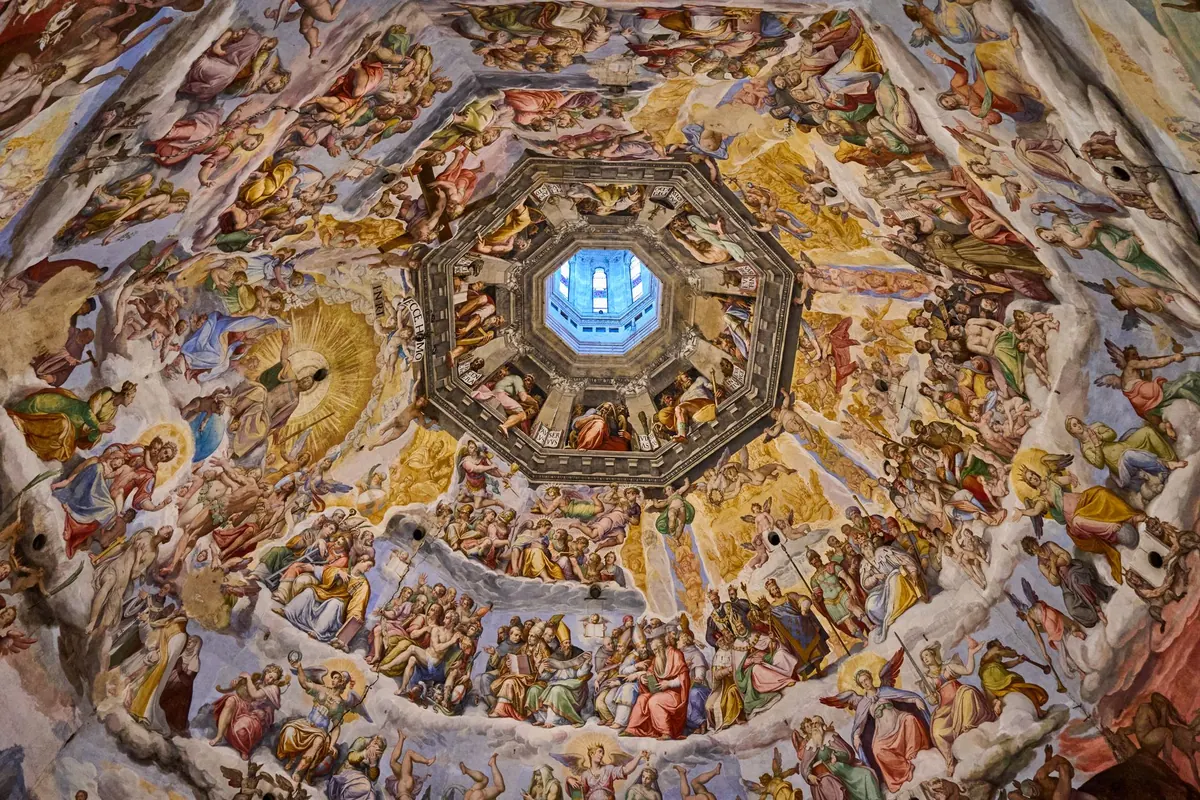
Not all Florentine frescoes are religious. In the Salone dei Cinquecento in Palazzo Vecchio, Vasari's ceiling and battle scenes are state propaganda at full volume, painted to glorify Medici rule. Nearby, the small chapel of Eleonora is Bronzino's. In the cathedral, look for the two painted equestrian monuments in the nave: Paolo Uccello's Sir John Hawkwood of 1436 and Andrea del Castagno's Niccolò da Tolentino of 1456. They are monochrome, painted to look like sculpture, and easy to walk past. If you climb the dome, you pass the Last Judgment by Vasari and Zuccari from a few feet away — worth the ticket on its own. (The Baptistery's glittering ceiling is mosaic, not fresco; enjoy it anyway.)
Practical Notes for Planning a Visit
Frescoes live on cold stone, and Florentine churches are considerably cooler inside than the street. Carry a light layer even in July. Shoulders and knees covered will get you past the doorstaff at most churches; a scarf in your bag solves the problem in seconds.
- Book timed slots for the Brancacci Chapel and San Marco first, then build the rest of your days around them.
- Limit yourself to two or three fresco sites a day. Each one asks for slow looking, and the fourth wall of the afternoon will get a glance at best.
- Check opening hours the day before. Smaller churches and cloisters often close for a long lunch and reopen mid-afternoon, and some shut on weekday mornings.
- Visit during Mass only to pray, not to look. Step out and come back.
- Bring small change for coin-operated lighting, and binoculars if you have them — the best-preserved passages are often the highest ones.
Flash damages pigments, and rules vary from site to site: assume no flash anywhere, and follow the posted signs rather than what other visitors are doing. Finally, allow yourself one unplanned stop. The fresco you find by accident, in an empty nave on a Tuesday afternoon, tends to be the one you remember.
Photo: Gotta Be Worth It / Pexels