There is a moment, usually somewhere in the third hour of working on wet lime, when the wall stops feeling like a canvas and starts feeling like a clock. That clock is the whole difference between fresco and secco. Both methods put pigment on plaster. One fuses the color into the wall while the lime is still chemically alive; the other lays color on a surface that has already set, held there by a binder. The choice changes how you plan the work, how the colors behave under the brush, and how much of the painting will still be there in a hundred years.
The Chemistry Behind True Fresco
Buon fresco begins with slaked lime — calcium hydroxide — mixed with sand and water. Lime is caustic and it is also greedy: as the water leaves, the calcium hydroxide pulls carbon dioxide out of the air and turns back into calcium carbonate, the same mineral as limestone. That conversion is what makes the technique work.
Pigment is ground in water or lime water and brushed onto plaster that is still damp. There is no binder in the usual sense. The setting lime grows around the pigment grains and locks them into the mineral skin of the wall, so the color becomes part of the masonry rather than a film sitting on top of it.
The consequence is a hard deadline. You can only paint while the plaster is fresh — typically a working day, less in hot dry air, longer in cool humid weather. Fresco painters therefore plan in giornate: patches of intonaco sized to what they can finish before the lime goes off, with visible seams where one session meets the next. The wall goes up in coats — a rough binding layer, a levelling coat (arriccio) that carries the sinopia drawing, then the smooth intonaco that receives the paint, with the design transferred by cartoon and pounced charcoal.
Fresco Secco: Same Wall, Different Mechanism
Secco takes the opposite approach. The plaster is allowed to set and carbonate fully — weeks rather than hours — and the pigment is applied with a binder. Egg, casein, animal glue, gum, lime water or a modern medium all work; the pigment is no longer trapped by lime but glued to its surface. Between the two sits mezzo fresco, painted on plaster that is nearly set: damp enough for some penetration, dry enough to hold fine detail.
That change buys time and freedom. You can stop, come back tomorrow, glaze, soften an edge, scrape out a mistake and repaint it. But the bond is mechanical rather than mineral, and the binder is a separate layer that ages on its own.
How the Two Processes Differ in Practice
The order of work in true fresco is fixed and unforgiving:
- Prepare the wall, apply the base coats, and let them cure properly.
- Set out the drawing — sinopia on the arriccio, or a full-size cartoon pounced onto the intonaco.
- Lay only as much fresh plaster as you can paint in one session, with clean, slightly bevelled edges.
- Work from light to dark and from general to specific while the lime is still active, keeping the palette deliberately narrow.
- Leave the finished giornata alone. Corrections happen by removing plaster or by returning a secco later.
Secco reverses the pressure. You work on a stable, cured ground at whatever pace suits you, which makes it far more forgiving for students, for large designs assembled over several sessions, and for detail finer than a brush can comfortably manage on a damp, fragile surface. The trade-off is that every layer must be compatible with the one beneath it, and that too much binder turns the surface glossy — or makes it skin over and flake.
Durability: What Lasts, and What Fails First
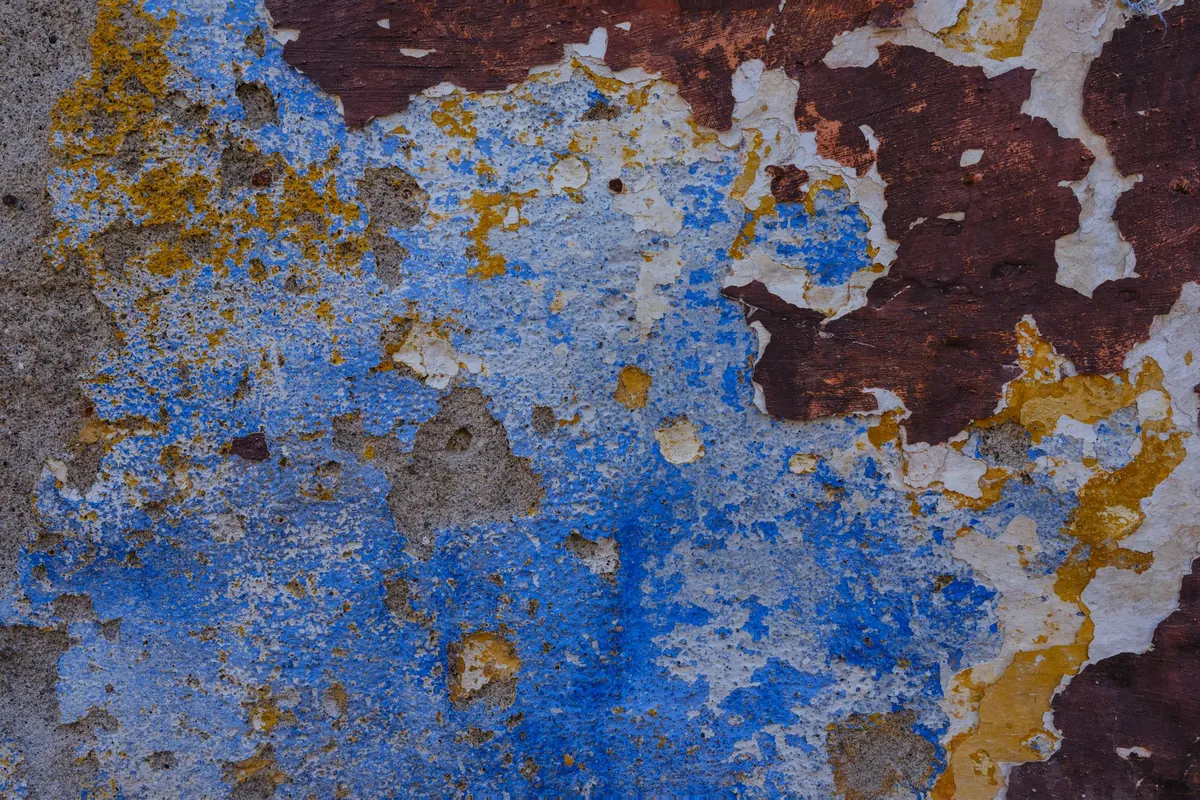
A well-made buon fresco is remarkably tough. There is no varnish to yellow, no binder film to embrittle, and the color will not fade in light. What damages it is water: rising damp, roof leaks and soluble salts that crystallise just under the surface and push the plaster away from the wall. Cracks in the masonry carry the same problem straight through the paint layer.
Secco is more exposed. Its binder is vulnerable to moisture, abrasion and repeated cleaning, and adhesion depends entirely on the plaster surface — dust, a slick trowelled finish or an over-sandy top coat will all weaken the grip. In practice, pigment layers applied a secco over a fresco are often the first thing a conservator finds lifting, and the reason over-vigorous cleaning can do real damage.
Color: The Lime-Fast Palette and the Drying Shift
Lime is alkaline enough to destroy a great many beautiful pigments, so the fresco palette is limited to what survives it. Dependable choices are the earths and iron oxides — yellow and red ochre, raw and burnt sienna, raw and burnt umber, green earth — along with lime white made from slaked lime. Ultramarine, azurite, vermilion and the organic lakes are altered or ruined by wet lime, and several modern organic colors are no better.
Then there is the drying shift. Wet plaster reads dark and saturated, so a passage that looks right on the wall can dry several values lighter, with whites blooming as the lime carbonates. Test every pigment on sample tiles of the same plaster mix and paint deliberately stronger than the result you want. Secco gives you the full palette, but the binder dictates the look: egg tempera sits deep and luminous, casein is matte, glue is glossy and yellows with age.
Where the Two Methods Meet
Most historic wall paintings are not one technique or the other. A sky of azurite or ultramarine, a vermilion cloak, a fine gold detail — these were traditionally laid a secco over a fresco underpainting, precisely because the lime would have destroyed them. Knowing this changes how you read a wall: the durable core is fresco, and the most brilliant passages are often the most fragile.
Choosing the Right Method for Your Project
Ask a few blunt questions before you mix anything. If the wall is damp, salts are blooming, or the building leaks, stop — no paint system survives ongoing water, and historic walls deserve a conservator's opinion rather than a DIY experiment.
- Is the surface stable, dry and sheltered? True fresco suits interior and sheltered exterior walls in sound masonry.
- Can you commit to day-sized sessions? If not, secco or a mixed approach will save you from cutting out failed plaster.
- Do you need a specific color? If the design depends on ultramarine or a organic red, plan it as a secco layer from the start.
- How much handling will it get? High-touch areas and humid rooms favour fresco, or a well-sealed secco with a protective finish.
- Test first. Brush each pigment onto a lime sample, let it carbonate fully, and check for bleaching, fading or a powdery surface before it goes anywhere near the wall.
Learn fresco and you learn to plan; learn secco and you learn to correct. Most painters end up using both, choosing the method giornata by giornata and passage by passage.
Photo: Engin Akyurt / Pexels